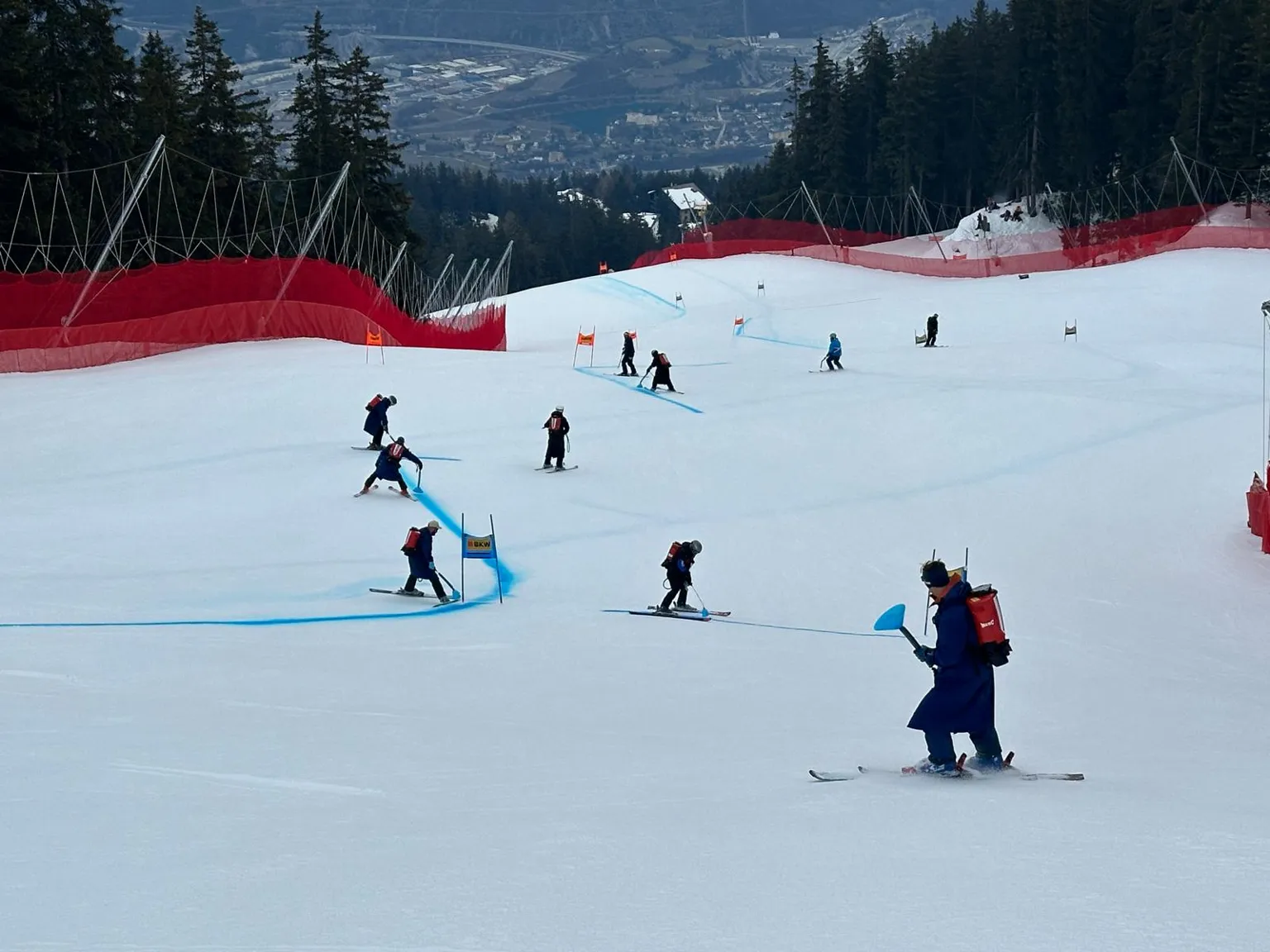
Behind the scenes
In the hut, there’s time to try the lance. Out on the course, we have just a few minutes once we get the all-clear. Follow the volunteers from the first refill to the last racer.
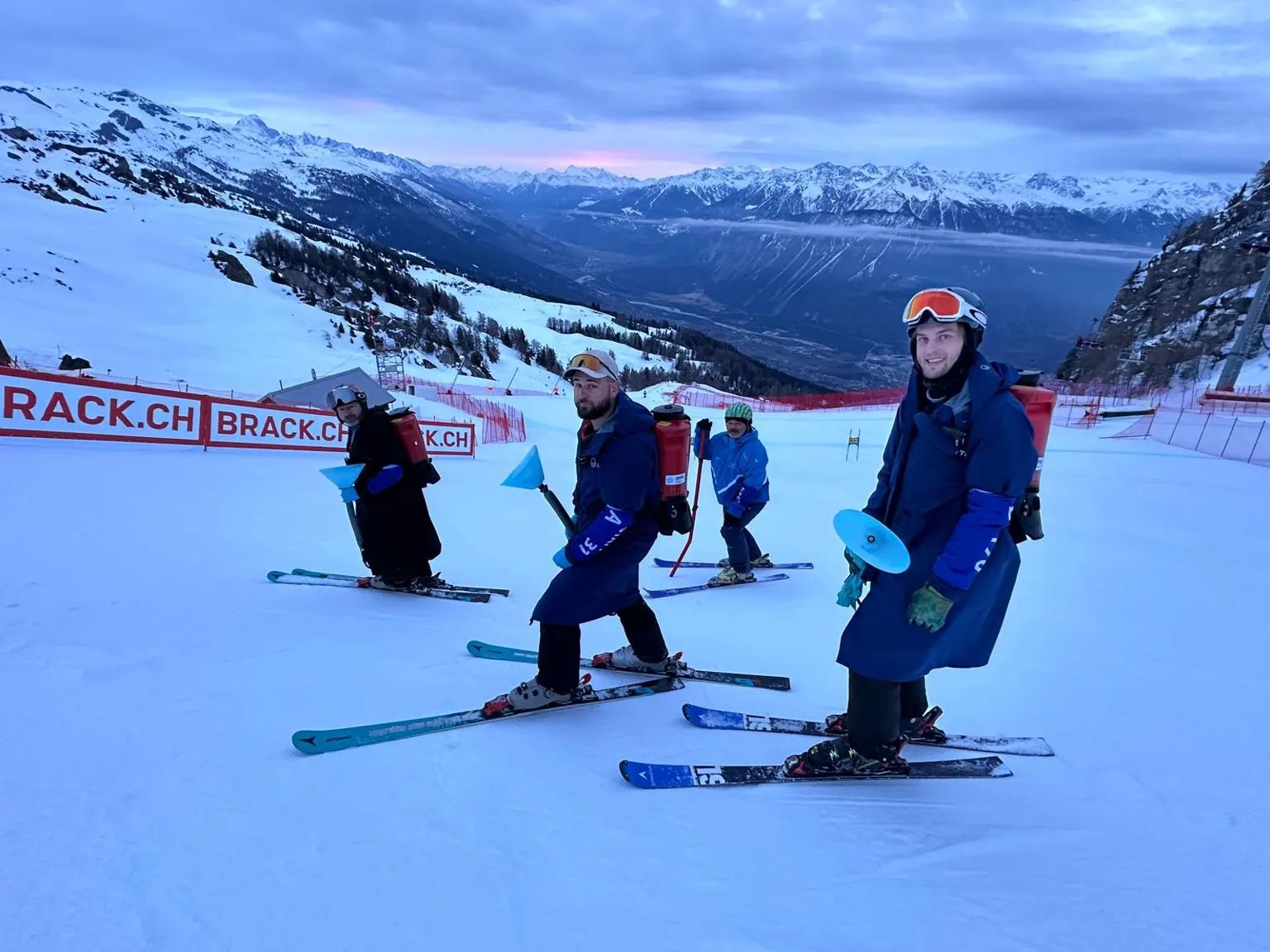
One Shot – a few minutes to make a difference
On the morning of a downhill in Crans-Montana, we usually have about half an hour to mark the course from start to finish before inspection, when the racers get a look at the course. By the time the crew leader radios us, each pair already knows which turn or roll they’ll be marking.
There’s no time set aside to practise on the course. If conditions allow, we put down the first marks the day before. Those lines already count. On race day we have to read the ground on skis, keep the lance steady and hand over to our partner. Any touch-up has to wait for a break in racing and the go-ahead from race control.
What happens before the first drop hits the snow
- In the hut
We mix water and blue dye, adding antifreeze if the cold calls for it. Then we fill our backpack sprayers, or “boilles” as we call them.
- At the tip of the lance
We check the pump, hose, fittings and nozzle. Even with a full tank, we need to see the mix coming out of the lance.
- Working in pairs
The crew leader assigns the sections. Before we set off, we each know our partner, our meeting point and which features need marking.
- On the all-clear
Once race control gives permission, the pair move onto their section. One marks while the other looks ahead, ready to take over.
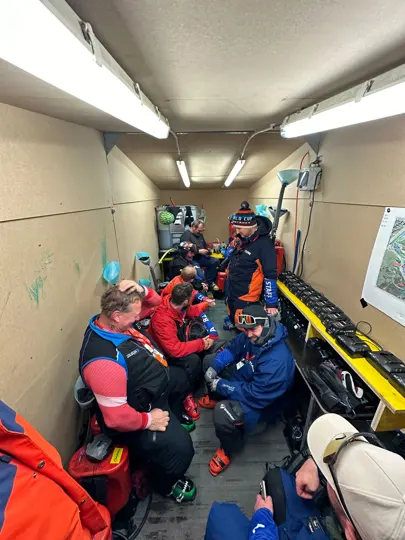
Two cabins, two roles
On the men's track, our technical support point is at the Cry d'Er jump. This is where Bertrand repairs the backpack sprayers. On the ladies' slope, the start hut houses a filling point and some spare parts. In each, a volunteer watches over the mixture.
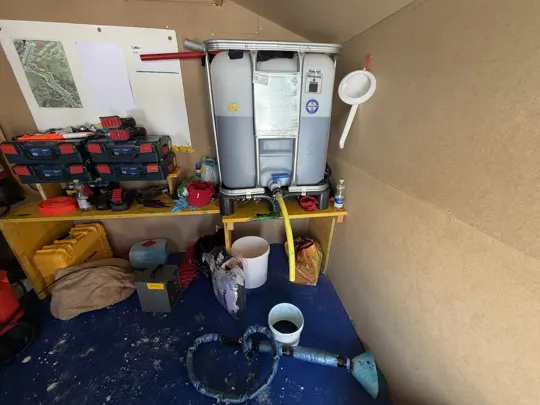
Who makes the blue potion?
The work begins with transporting water, dye and antifreeze to the cabins. In negative temperatures, the volunteer adapts the proportions to the cold. He also prepares a reserve: if visibility drops, skiers need even more landmarks and backpack sprayers return more quickly.
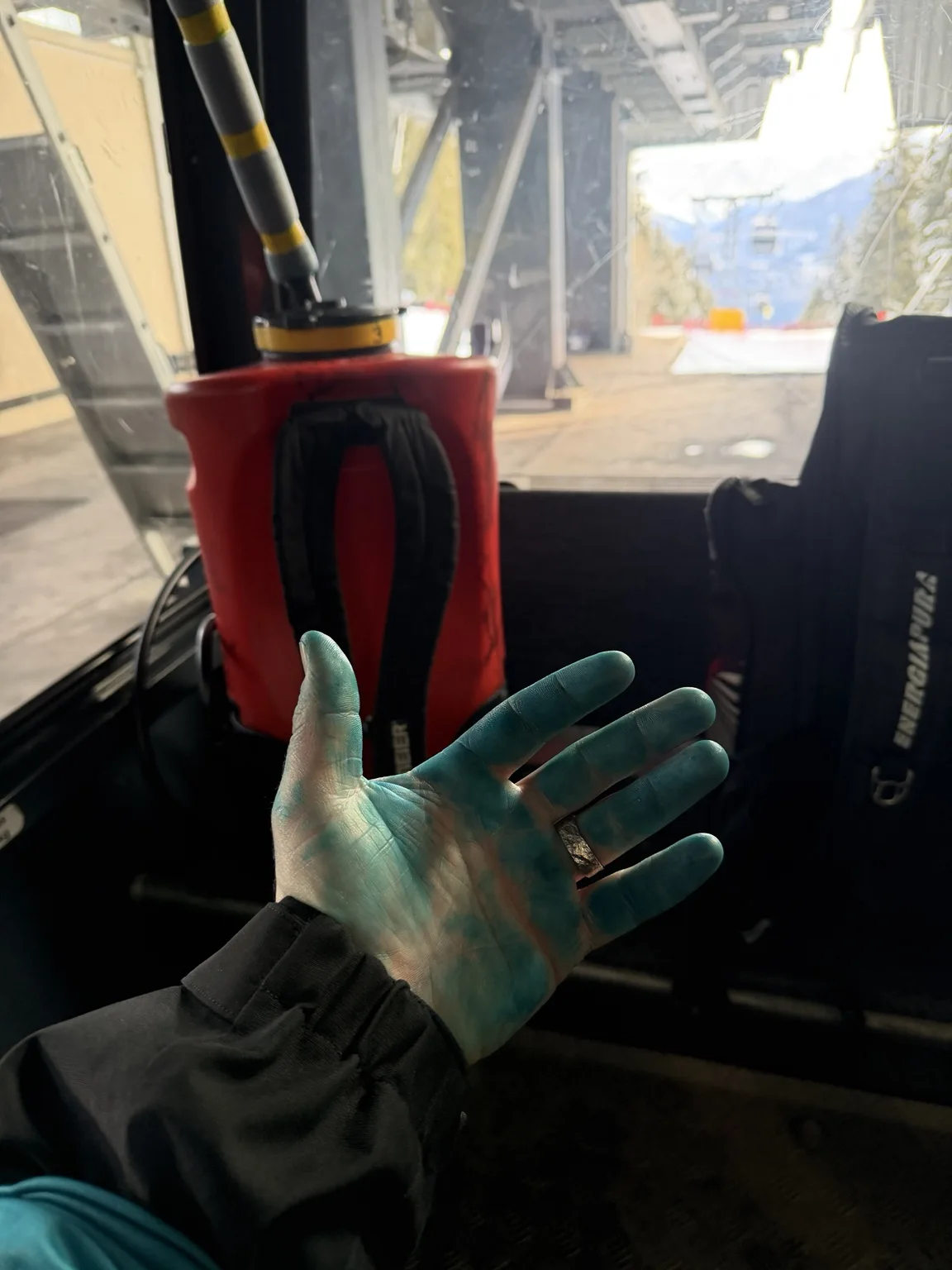
How do you recognize a Picasso?
To his big cape, already. All it takes is a dripping fitting, a freezing nozzle or a splashing nozzle to appreciate this funny outfit.
The pilgrim often saves the jacket. For the hands, the result is more random. At the end of the day, you quickly know who worked on the blue!
🎨 The art of drawing the track before the champions
If the weather and track preparation permit, we take out the backpack sprayers the day before. We have time to take care of the curve and lay down a first regular line. A night of snow, wind or work still in progress, and everything depends on the early morning. Our deadline is the recognition of athletes: the first benchmarks must already be in place.
The leader's perspective
Before guiding the team, the leader observes the course, imagining the skier's descent. Where will he pick up speed coming out of the corner? After the jump, where will his skis find the snow? From up there, will he see the slope break soon enough? It is this look that gives the line its place, leaving the runner his trajectory.
To each his own spear
The technical delegate or race officials may request a more marked mark on a bump. To draw it, Picasso works freehand. Without a dress rehearsal or a dedicated training track, the eye is trained during races, by following a colleague and by interacting with other teams. Two marking teams will each have their own trait. At more than 100 km/h, what matters for the athlete is being able to read the terrain.
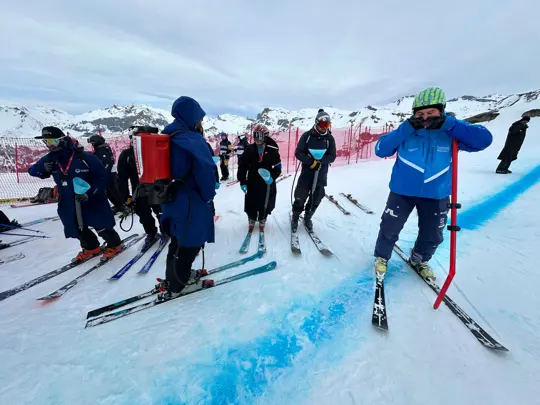
10 to 20 Picassos at the cabin
Imagine ten Picassos arriving on skis, their backpack sprayers almost empty. Sometimes there are twenty of them! We fill the backpack sprayers, check the lances and everyone leaves for their sector. Meanwhile, at the cabin, we already have to think about the next wave.
Bertrand, my nozzle is clogged!
A connection is leaking, a battery is loose, a nozzle refuses to spray. While Bertrand takes care of the breakdown, one or two Picassos provided in reserve can take over on the track. The pair can thus continue marking during the repair.
300 to 500 liters for a race
This is the order of magnitude that we observe in Crans-Montana for the entire mixture, water included. In poor visibility, you sometimes have to go over certain lines. We can then use a third more, or even double when the conditions are particularly difficult.
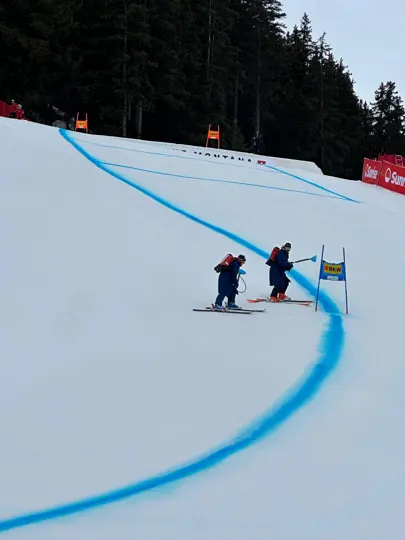
The relay, almost a dance
On hard snow and steep slopes, your legs tire quickly with a full backpack sprayer. One traces, the other accompanies him, observes the terrain and stays ready. A look, a change of pace, and the second extends the line. From the edge of the track, we see a continuous line. On the skis, you feel all the work done by two people.
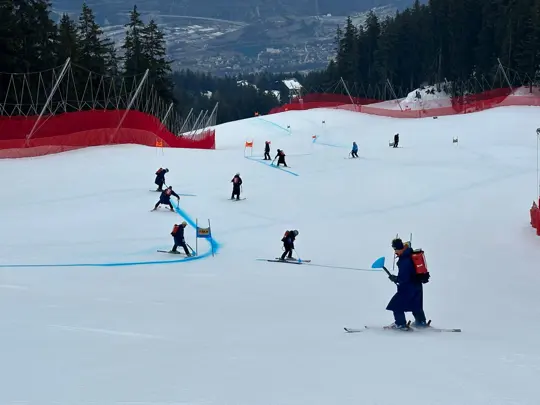
A bump to pick up during the race
The technical delegate signals to the leader the passage to be reinforced. The leader transmits the request to the Picassos in the sector. Everyone has their own radio: during a short interruption, sometimes a television break, the pair knows exactly where to turn on the blue. The radios remain on until the last competitor.