Why does this blue line cross the slope right here?
Under an overcast sky, the shadow of a roll can disappear. A blue mark across its crest shows where the ground drops away. Each racer chooses their own line between the gates.
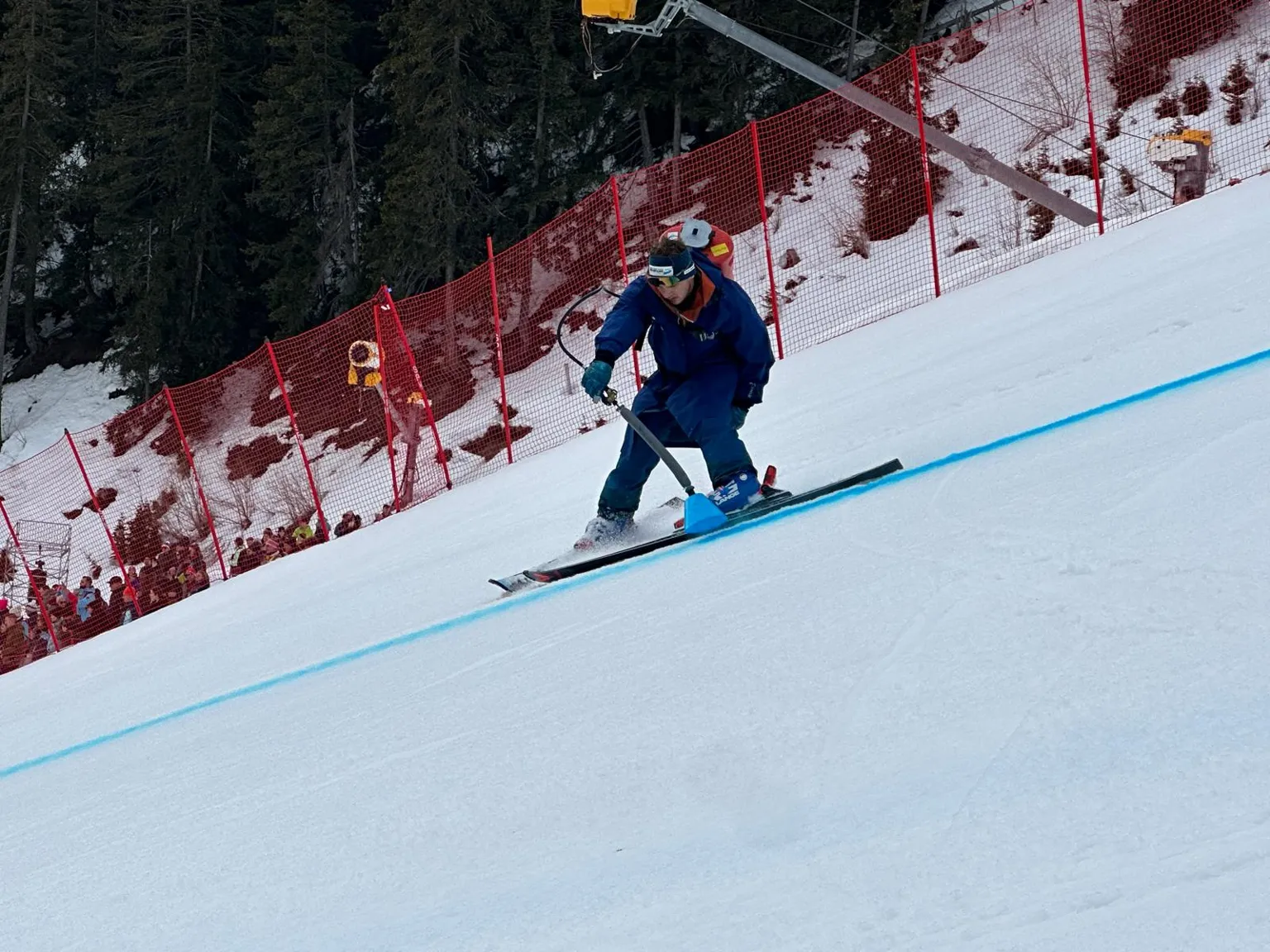
Here in Crans-Montana, we’re the Team Picasso volunteers who paint those marks. Before the racers inspect the course, we ski down in pairs without poles. One person guides the lance while the other looks ahead to the next roll.
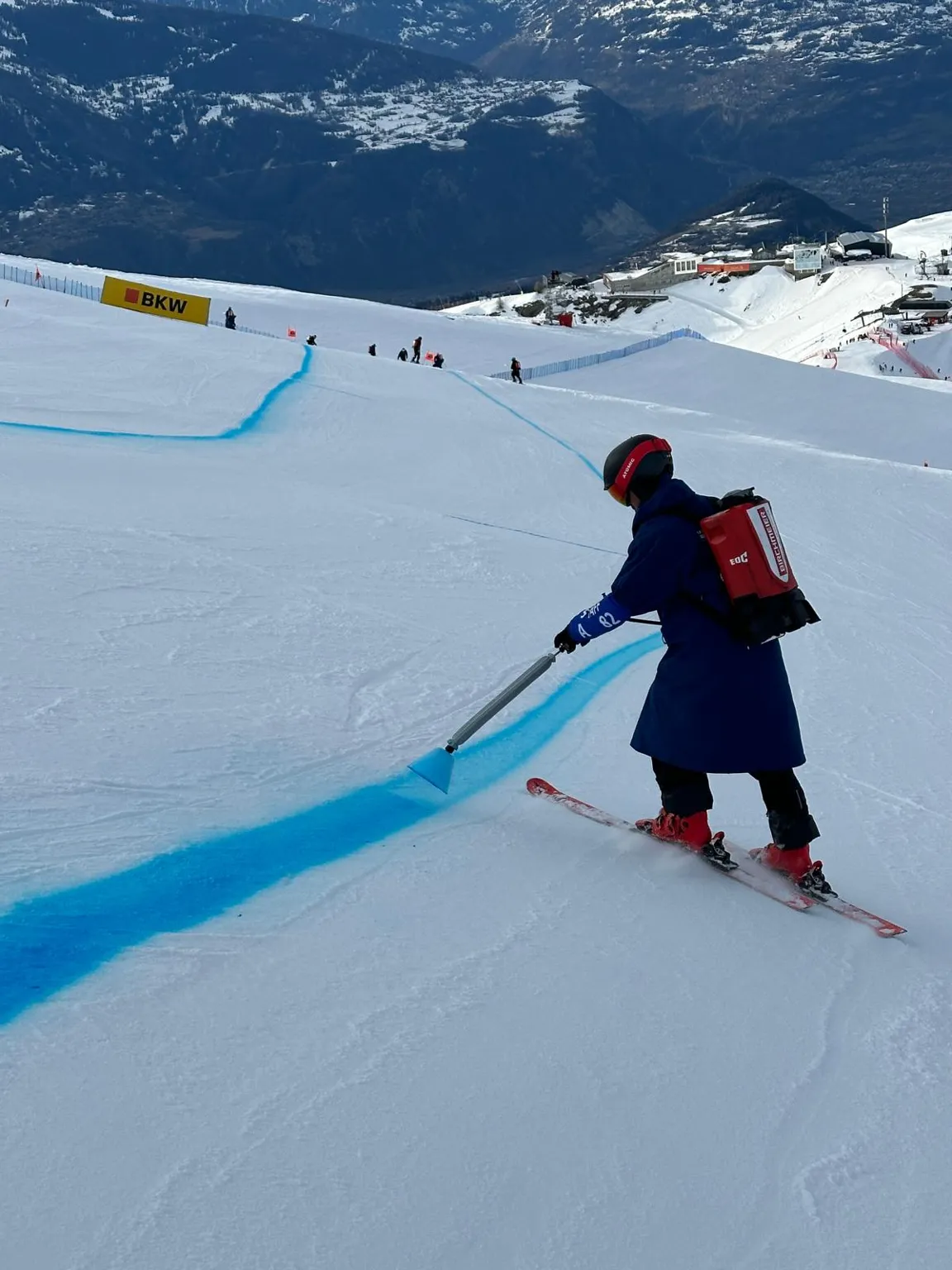
The marker guides the blue spray hood close to the snow in the turn. Crans-Montana World Cup, winter 2026.
Curves by the gates, stripes across the rolls
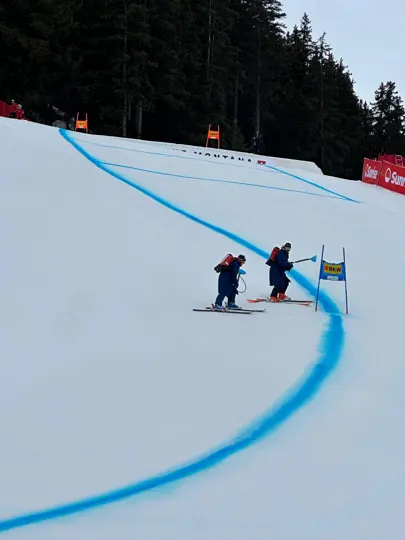
Look at the two Picasso by the gate. From above, the long blue curve makes the turn easier to see. A stripe drawn across the slope gives a different cue: the gradient changes here.
2026 World Cup. The blue curve runs right past the gate. Higher up in the photo, two marks run across the snow.
A turn seen from above
The arrow points downhill. The long curve runs past the gate. The short line across the slope draws attention to a change in gradient.
The same roll, looking downhill
Without the blue
With the blue
Look for the crest in the middle of each picture. In flat light it blends into the snow. The blue mark shows where the ground drops away.
Where does the Picassos’ blue come from?
On TV you see a blue line stretching down the snow. At the end of it is a volunteer on skis, spray lance in hand. Inside the ‘boille’, our name for the backpack sprayer, is water tinted with snow-marking dye.
The long curve follows the turn. A short line across a roll shows where the slope drops away, especially when the shadows disappear. Work on that first line begins in the hut, well before the start.
Look just above the snow. Under the blue spray hood, the jet picks up where the line ends.
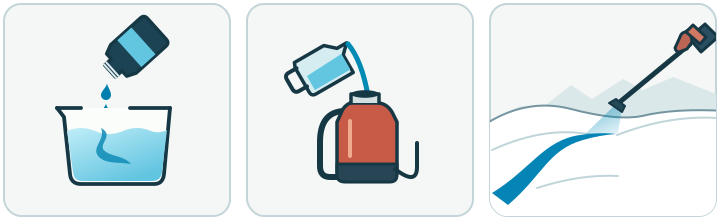
From concentrate to course marking
Dilute the dye in water
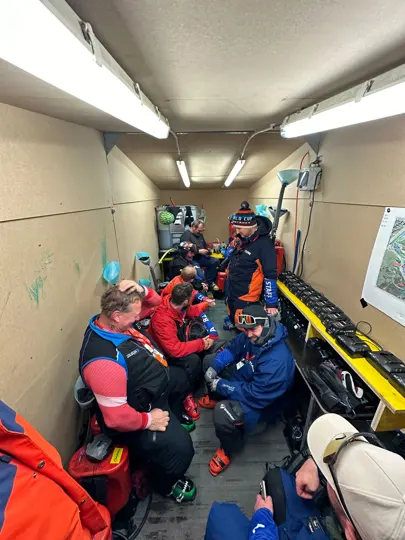
Fill the backpack sprayer in the hut
Spray the mark on the snow
The blue dye we prefer
At Crans-Montana we favour blue TRAWOSA Color Mark. Pieren Top Products AG in Adelboden, in Switzerland’s Bernese Oberland, distributes this concentrate for marking snow. A little mixed into water gives the line its vivid blue.
When the snow melts, what we sprayed can reach the soil and waterways. We prepare the quantity we need, take care with dilution and fit a hood around the nozzle to limit spray drift in the wind.
Pieren describes TRAWOSA as biodegradable. We still need the test report to understand the conditions and limits of that claim. We’ve also trialled ColourPro Indicator. Out on the course, our aim is a mark the racer can read, using just the amount it takes to draw it.
“Boille” is our word for the backpack sprayer. With the tank full, the whole kit weighs about 25 kg. On steep ground, the observer can take a turn with the lance. Back in the hut a volunteer prepares the next refill.
What happens during a race?
We wait for the go-ahead from race control over the radio. If a mark fades, two of us can ski out to refresh it during a break, such as a TV break. From the fence you may see the lance pass over the blue again.
The hut is where we check that the pump delivers. Out on the course, each pair has just the window race control gives them.
The photographs in this story are from the 2026 World Cup. For the 2027 World Championships, the team is preparing to return to Mont Lachaux and the Nationale.