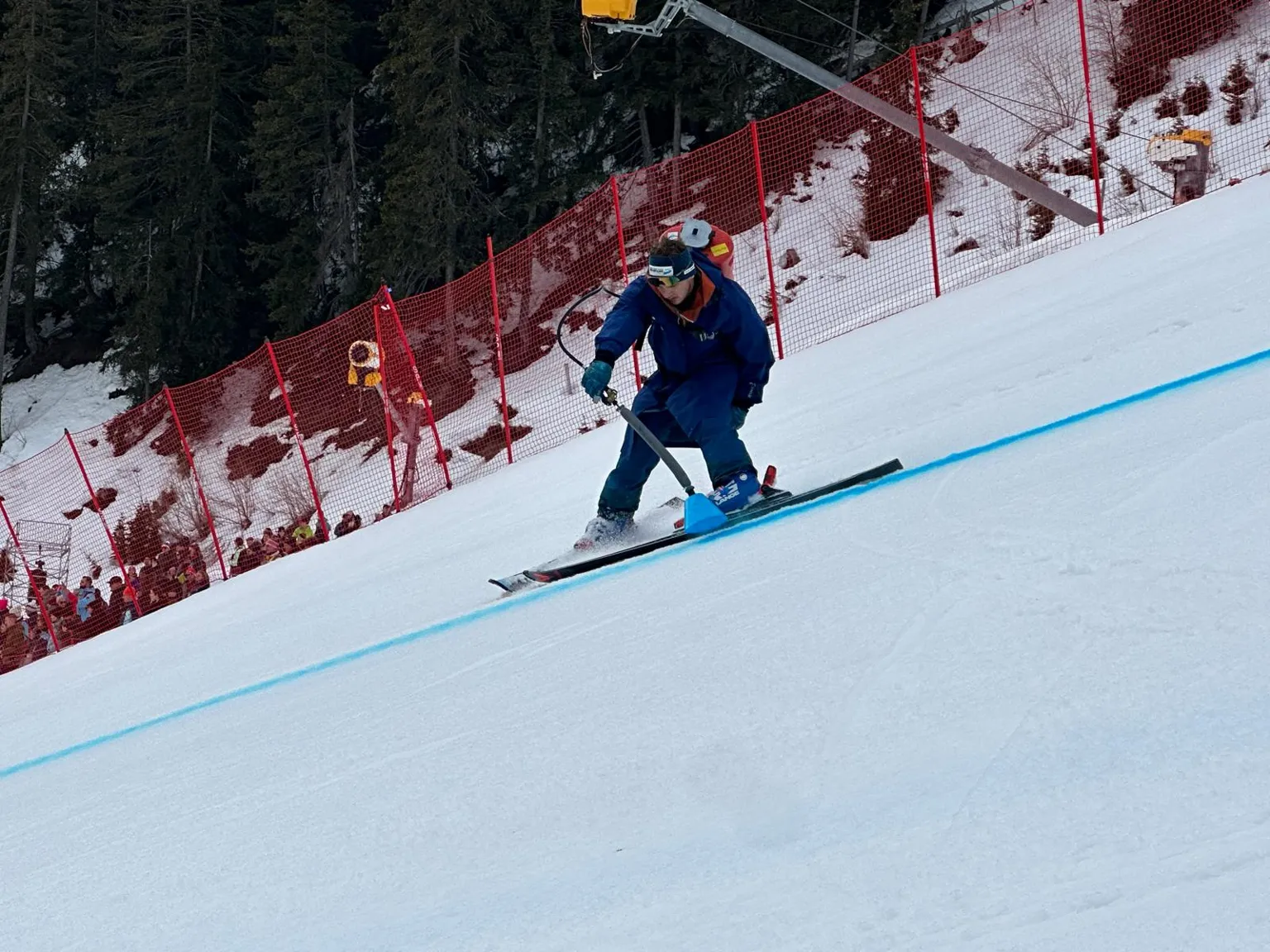
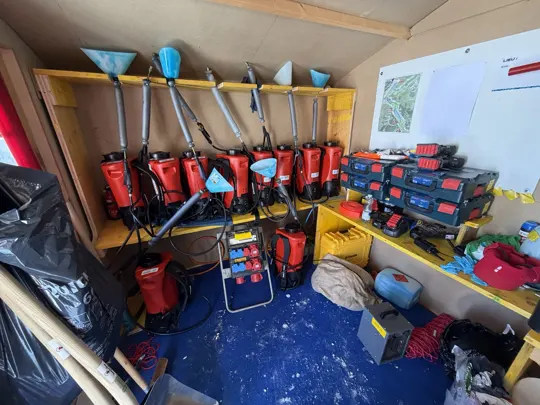
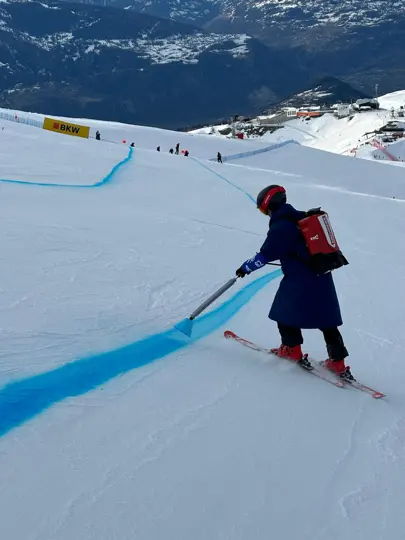
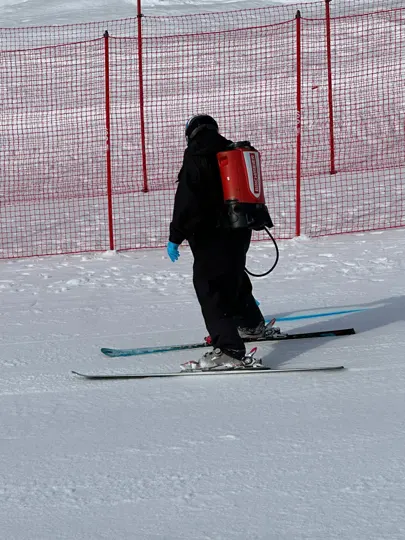
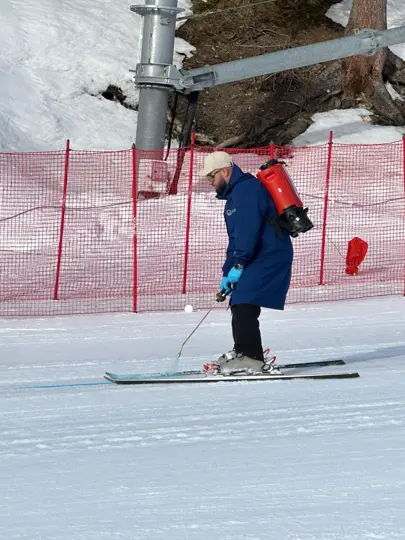
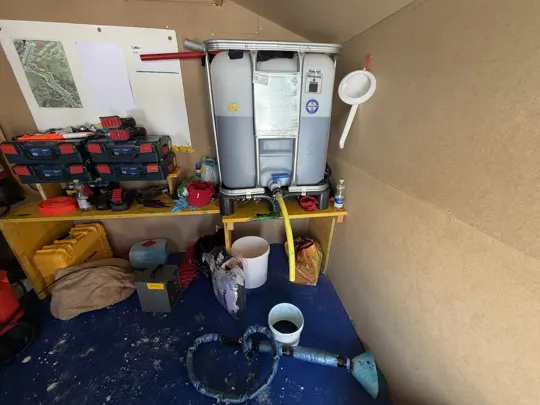
“Boille” is our word for the sprayer we carry on our backs. From the hut to the last run, see how we get our kit ready and mark the snow on skis, lance in hand.
The art of marking: how the Picasso crew draw the blue lines
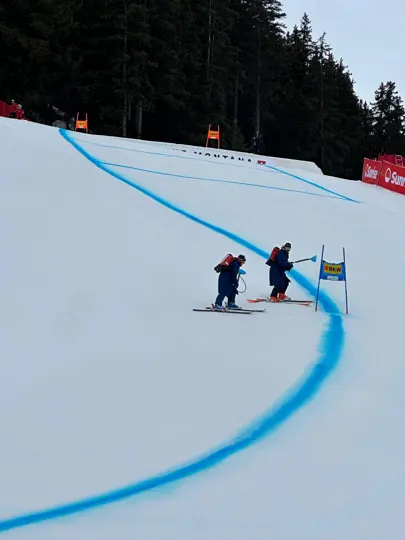
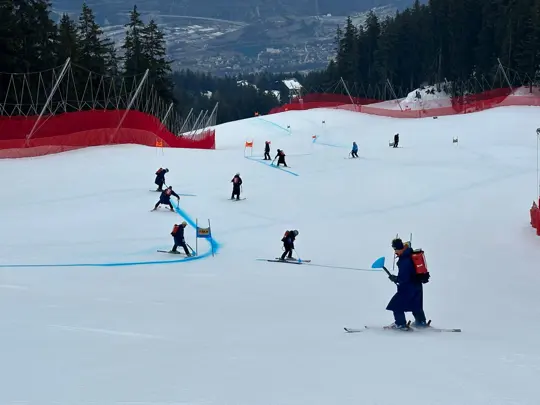
From the side of the course, you can see a blue curve beside the gates and a short line across the crest of a roll. These marks help racers read the terrain. Each racer chooses their own line.
Look for the blue hood at the tip of the lance. As the marker skis forward, the spray footprints overlap to form a continuous strip.
Before we put our skis on
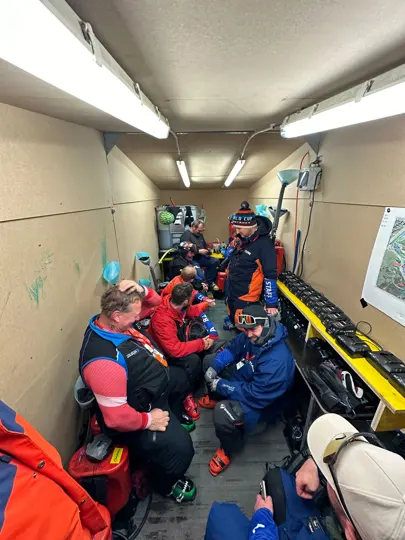
In the hut we prepare the ‘boille’, our backpack sprayer, and check the spray pattern and radio. During course inspection we identify the gates and changes of gradient to highlight with the marking lead, then divide up the sectors.
How high should the nozzle sit?On the left, a fan close to the snow makes a narrow footprint. Raising the nozzle, on the right, spreads the same amount of liquid across a wider strip. The droplets also spend longer exposed to wind.What happens when you tilt the lance?On the left the spray axis is perpendicular to the local snow surface. Tilting it shifts the footprint forwards or sideways. When the tilt lies in the plane of the fan, the far edge of the spray travels further.How does travel speed change the line?At the same flow rate, travelling slowly deposits more liquid per metre (top). Travelling faster spreads it over more distance (bottom). A steady pace, height and orientation help keep the colour even.What pattern reaches the snow?From above, the 6504 makes an elongated footprint. The theoretical footprint of the 1.5 mm Duro hollow cone is a ring. These patterns overlap as you move. Flow, snow surface and wind also affect the width and intensity of the mark.Where does the line go on a roll?The cross-section shows a change in gradient. On the right, the plan view shows a line running across it to bring out the change in slope. The location is agreed during inspection with the technical delegate.
Our setting is 3 bar with either nozzle. Very close to the snow, small arm movements show up in the line. Follow the ground over rolls and across the slope to keep the gap and travel speed consistent.
Two ways to understand the mark
At constant flow, litres per metre = flow (L/min) ÷ travel speed (m/min). Worked example: 1.5 L/min at 30 m/min gives 0.05 L/m, or 5 L per 100 m. To try this in the calculator, enter the equivalent speed of 1.8 km/h.
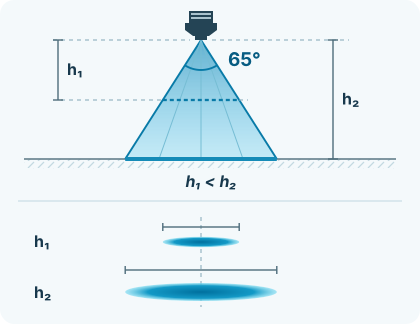
For the 6504 aimed at right angles to a flat surface, theoretical width = 2 × height × tan(65° / 2). Measure height perpendicular to the snow. Width and height use the same unit. Wind, tilt and uneven snow affect the actual strip.
At 3 bar the reference tables list 1.58 L/min for the TeeJet 6504 used for comparison and 0.93 L/min for the 1.5 mm Duro (28502324-SB). At equal travel speed, higher flow puts more liquid on each metre of line. We measure actual lance output in the hut.
Watch the gap between the nozzle and the local snow surface. At a breakover the snow drops away from the hood if your hand stays level. A line across the course brings that change into view.
On hard or fresh snow
Look at the strip you have just laid down. Its contrast and the definition of its edges can vary with the surface. The crew judge the need for a touch-up by looking at the mark on the snow.
In wind or flat light
The hood helps contain the spray. When shadows disappear, look downhill from above the mark, as an approaching racer would, and check that the line is continuous.
On compact snow the dye may stay near the surface. Fresh snow can absorb it or cover the mark. In fog we reassess the visual references with the person in charge. In severe cold the mix must stay fluid all the way to the nozzle. Follow the instructions for the antifreeze product.
Working in pairs
The lead marker sets the line. Their partner carries it through from the preceding section. Pairs coordinate by radio in response to the technical delegate’s requests. During a race they wait for a scheduled interruption and clearance from the person in charge before entering their sector.
The lead marker lays down the first line. If a mark disappears, a TV break can provide a window to refresh it. The pair waits for radio clearance before entering the course. Even with identical equipment and pressure, looking back at the result and comparing notes helps volunteers refine their technique.
How much mix do I need for 100 m?
I already know my flow rate and speedSee how your technique changes the line
The simulator shows the 6504 flat fan nozzle. Move a slider and watch the blue strip change. At × 1 you are back at the starting setting.
Left, a side view of the fan. Right, a top view of the strip. Darker blue shows a more concentrated deposit.
Volume per metre relative to the reference pass
Theoretical model at a constant fan angle, on a level surface without wind. For the same nozzle, flow varies here with the square root of pressure. Speed affects liquid deposited per metre. Height spreads that liquid across a wider or narrower strip. The simulation gives no on-snow settings.
We call our backpack sprayer the “boille”. Its pump feeds the mixture from the tank to the lance.
For organisers
Our course version of the Birchmeier REB 15 AC3 has a 15 L tank, an 18 V / 72 Wh CAS battery and a charger for 230 V. The whole kit weighs about 25 kg when full. The pump reference and modifications are still to be documented.
Nozzles and lances
The nozzle at the tip of the lance shapes the spray. We use both a 6504 flat-fan nozzle and a round spray nozzle.
6504 generally denotes a nominal 65° angle and flow size 04. Pressure and distance affect the width. Skiing speed affects the amount per metre. Still to document on our equipment: the make and exact part number of the 6504, measured pressure and flow for both nozzles, marking width on snow and compatibility with the lance and hood.
The hood surrounds the nozzle and shields the spray from wind just before it reaches the snow.
For organisers
It helps keep the edge neat and limits dye dispersion. The attachment and compatibility of each setup remain to be documented.
Hoses and frost
Liquid in the hose can cool down even during a chairlift ride. Insulation slows that cooling.
For organisers
The nozzle remains sensitive to cold. We check the spray in the hut before setting off. The insulation material and mounting details remain to be recorded.
The blue mixture
We favour blue TRAWOSA Color Mark and have also trialled ColourPro Indicator. When the cold calls for it, we add a RIWAX concentrate to the water.
Preparation depends on conditions. Follow the manufacturer’s information for handling each product. Team mixing ratios are undocumented here.
Huts and refills
The huts supply the crews with mixture and spares. Sometimes ten Picasso skiers arrive almost at once.
For organisers
At the Cry d’Er jump, Bertrand looks after connectors, nozzles and batteries. The women’s start has a second refill point and spares. After a repair, the lance is tested before its return to the hill.
Radio and coordination
When race control requests a touch-up, the team leader radios the pair responsible for that sector.
For organisers
Radios stay on until the final racer. A TV break alone is not clearance to enter the course. Sector assignments and radio channels are confirmed for each race.
Using the refractometer in the hut
We dilute Riwax antifreeze concentrate with water. A few drops of the prepared mixture are enough to see the boundary between the light and blue fields in the eyepiece. Turning that reading into a temperature requires a scale calibrated for the liquid.
From prism to eyepiece
Schematic with no numerical scale.
Check the zero point as described in the instrument manual. Place a few drops on the clean prism and lower the clear cover so the liquid spreads without air bubbles.
Look through the eyepiece and bring the scale into focus. Read the appropriate scale where the two fields meet. Clean the prism after use as directed in the manual.
Which scale should you read?
On the dial shown, the windscreen symbol identifies the washer-fluid scale (SRF1). G13 and G11/12 are glycol scales. The battery symbol marks a density scale in kg/L.
We still need to confirm whether the washer-fluid scale matches our dilution of Riwax concentrate. The diagram shows how to take a reading and gives no frost-protection temperature.
Two nozzles for the blue line
The nozzle at the tip of the lance shapes the spray before it reaches the snow. On our Birchmeier REB 15 AC3 backpack sprayer we use a 6504 flat fan and a Duro hollow cone. Here’s how to read their patterns and plan for a race.
Seen in the plane of the fan, the spray gets wider with height. From above, the footprints at h₁ and h₂ are elongated strips.
In the common nozzle code, “65” gives the nominal 65° spray angle and “04” the flow size. The TeeJet TP6504, for reference, delivers about 1.51 L/min at 2.76 bar (40 psi). Actual flow depends on the make, the condition of the nozzle and the operating conditions.
Birchmeier Duro · Hollow cone
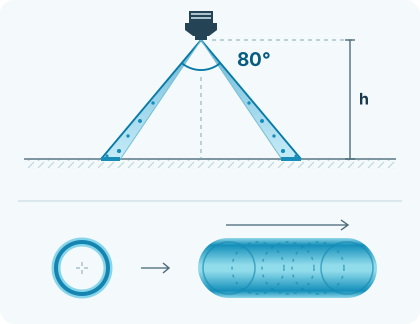
In cross-section the droplets follow the cone wall. Viewed from above, a stationary ring becomes a strip of overlapping rings as the skier moves.
The 1.5 mm Duro-Nebeldüse produces an 80° hollow cone. Most droplets travel along the outside of the cone. As the skier moves, successive rings overlap on the snow.
G1/4″ connection · brass and stainless steel Manufacturer’s part number 28502324-SB EAN 7611034100166
Principle diagrams with the lance perpendicular to a flat surface. The patterns shown are not measurements taken on snow.
Comparing the nozzles at the same pressure
Characteristic
6504 · Flat fan
Birchmeier Duro · Hollow cone
Pattern and nominal angle
650465° flat fan
Duro80° hollow cone
Catalogue flow at 3 bar
65041.58 L/min (TeeJet TP6504)
Duro0.93 L/min (Duro 1.5 mm)
Liquid distribution
6504A flat, elongated sheet
DuroDroplets concentrated around the cone wall
Distance from snow
6504Raising the nozzle widens the band. Its orientation follows the lance.
DuroRaising the nozzle increases the ring diameter.
Mark while moving
6504The fan sweeps a band whose width depends on its orientation.
DuroThe rings overlap. Skiing speed changes the amount per metre.
What to check
6504Fan orientation, a consistent line and the condition of the orifice.
DuroCone symmetry, wind and the effect of the spray hood.
Planning notes for race organisers
In the hut
Set out the sprayers, charged batteries, chargers, spare nozzles and fittings, and cleaning kit. Agree on an accessible refill point.
Mixing
Prepare the blue dye and a frost protection product suited to the expected temperatures. Follow product and team instructions for mixing and cleaning.
On the snow
Check the spray on the day’s surface. Hard or fresh snow, temperature, wind and visibility can all change how the line reads. Recheck it as the surface changes.
Before course inspection
Agree sectors, access, pairs, radio channel and clearance for touch-ups with the technical delegate and race control.
Planning refills
At the same flow rate, skiing more slowly deposits more liquid per metre. Longer lines and repeat passes increase demand. Allow separately for trials, refills and travel.
How long will the lance be open along your line? Enter the length of one pass and your average speed while spraying. Only pressures with a documented flow rate for the selected nozzle are available.
A theoretical estimate for continuous spraying at constant speed. Time excludes lift rides, stops and refills. Conditions and the mixture can affect actual consumption.
Time (min) = length (m) × number of passes × 0.06 ÷ speed (km/h). Volume (L) = time (min) × flow (L/min).
From tank to snow
The nozzle at the end of the lance shapes the spray. The hood around it helps shield it from the wind.
Lessons from other races
Hahnenkamm · Kitzbühel
In Kitzbühel, Gerhard Raffler recalls trials with Easter egg dye, beetroot juice and berry juice. Residue caused problems in the pump.