
Skip to content
Team Picasso
EN

For organisers

Marking the course at Crans-Montana

This is how we prepare the blue lines at Crans-Montana. Other race committees can use our experience to compare their course, crew and race-day needs with ours.

The tank, hoses and refill cans inside our equipment hut.

Questions for the course meeting

  1. Which sectors need marking and how will pairs be assigned?
  2. Where can we refill and store spare batteries and nozzles?
  3. Who gives clearance by radio and how much time is available before course inspection?

Technical field guides

Measure flow, estimate consumption and simulate a line →

Equipment

Backpack sprayer
Birchmeier REB 15 AC3, piste model · 15 L tank
Battery and charger
18 V / 72 Wh CAS system · 230 V charger
Spray shields
Two push-fit shields for the REB: oval or round, 12.5 cm in diameter

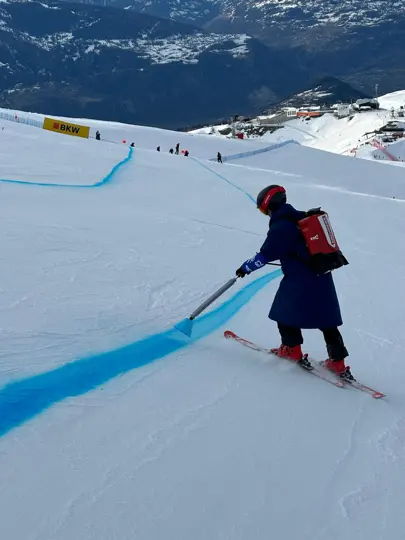
An insulated hose connects the tank to the wand. The shield shelters the spray from the wind just above the snow, limiting drift. Before leaving the hut, we test the trigger and check that the nozzle produces an even line.

See the sprayer developed for the Picassos
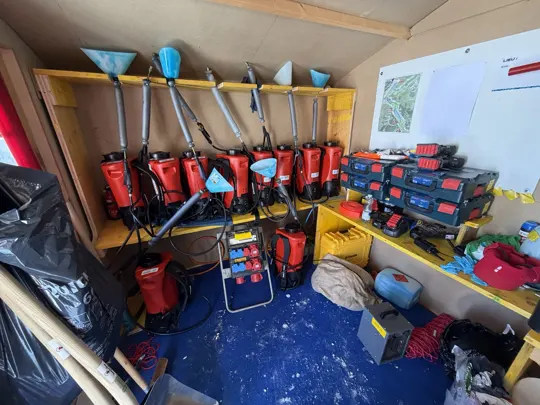
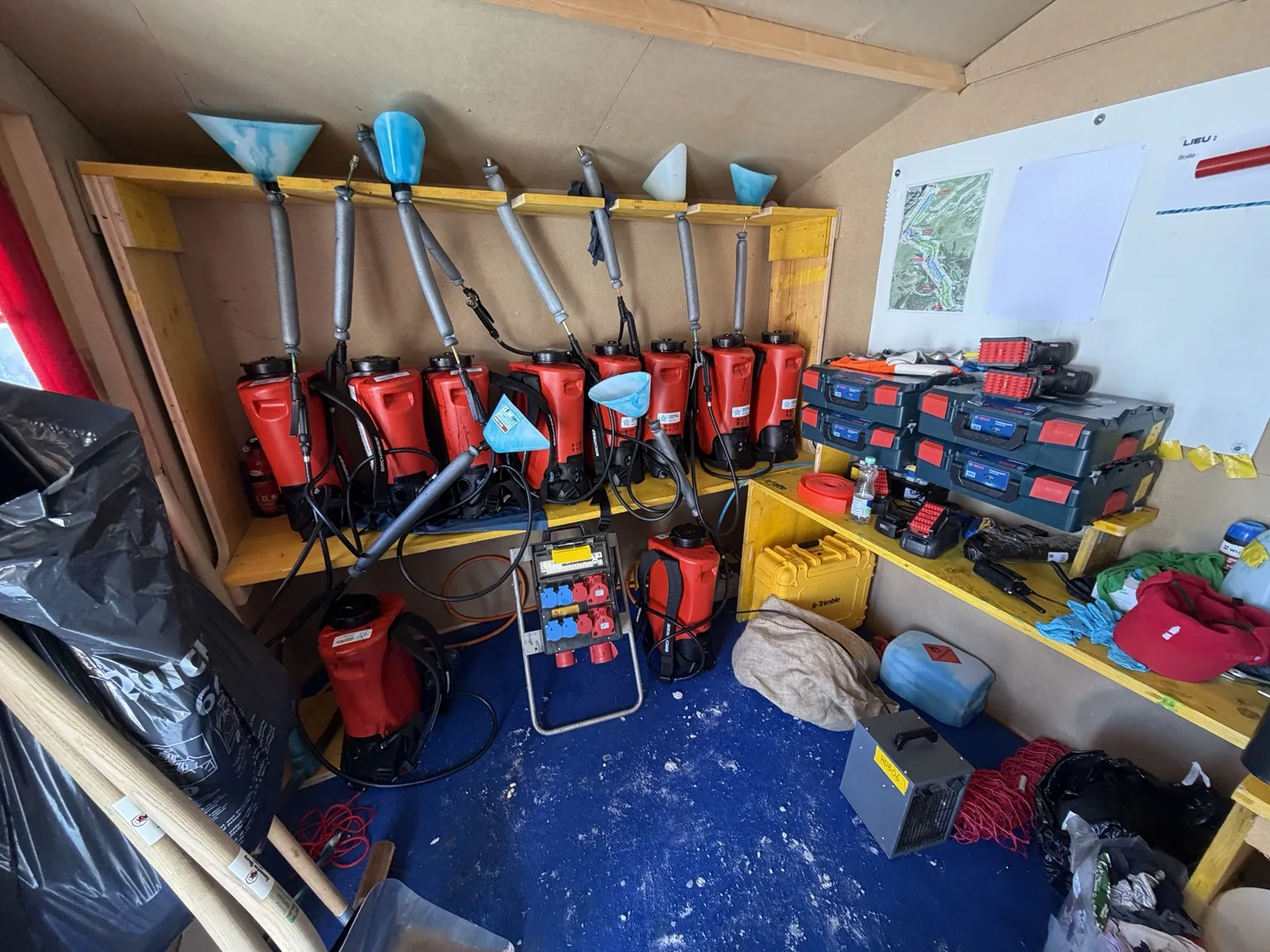
Backpack sprayers and wands ready in the hut.

Dyes and preparation of the blue marking mix

At the briefing we identify the sections to mark and where touch-ups might be needed. Back in the hut, that comes down to one question: how much liquid should we prepare for the pairs heading out?

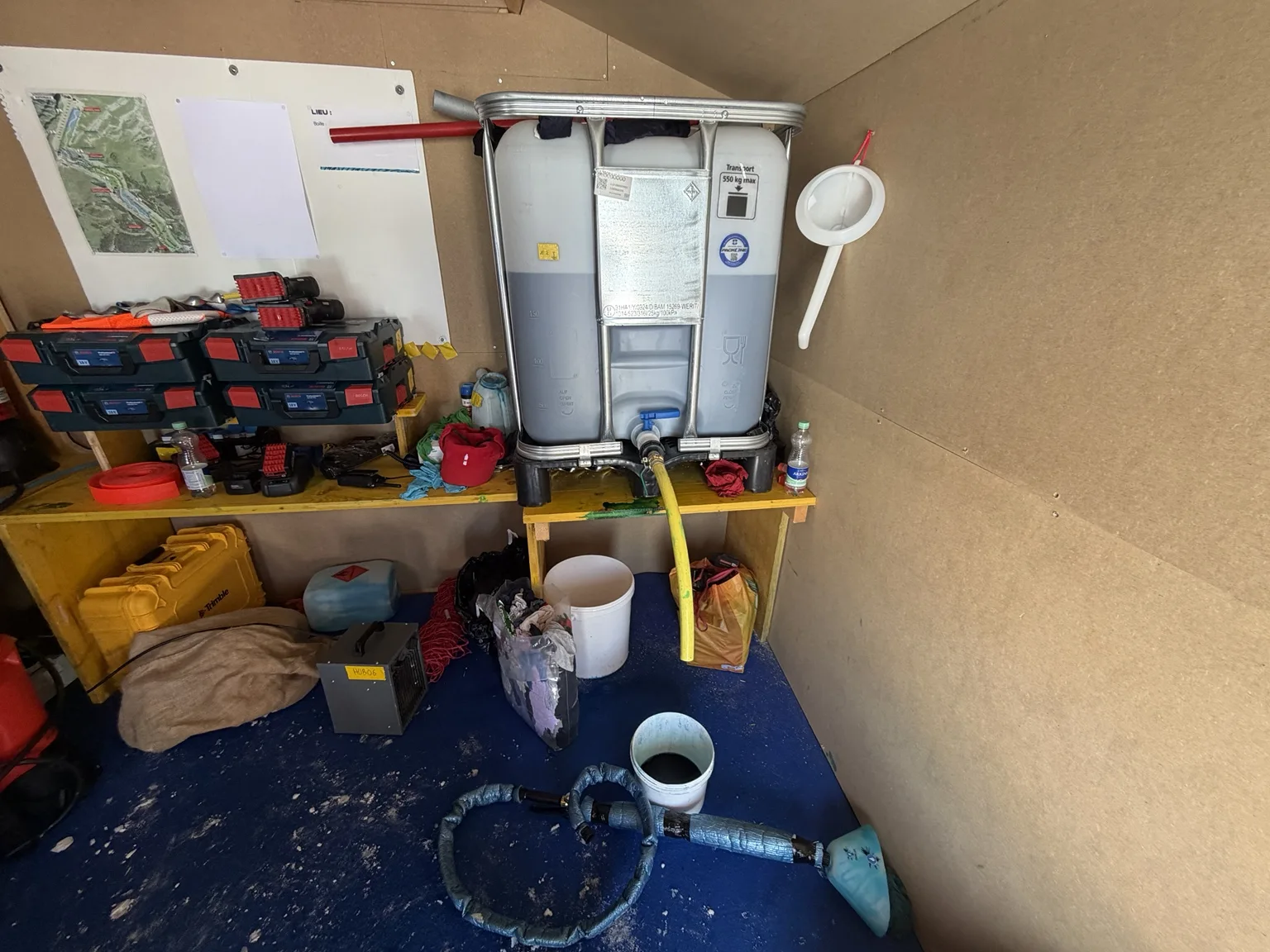
Mixing tank, hose, funnel and buckets inside the hut.
In the hut, a hose leads from the tap on the mixing tank. The funnel and buckets are within reach.

The two dyes our team has used

Blue TRAWOSA Color Mark · P7085

This is our preferred dye for snow. Pieren Top Products AG, the Swiss distributor in Adelboden, lists water, blue food colouring E133 and polyethylene glycol (PEG) as the ingredients. Pieren also reports its use at World Cup races and on an Olympic course in South Korea.

The supplier gives a ratio by volume of one part concentrate to 70 parts water. That makes 71 parts before any antifreeze is added. On the course, we choose the dilution to suit the conditions and how well the mark shows up.

The supplier describes the dye as biodegradable. We still need documentation of the test method, conditions and result.

ColourPro Indicator · 08599

We have also trialled this liquid blue dye in an aqueous solution. According to its safety data sheet dated 11 March 2019, the product is not classified as hazardous under the CLP Regulation. Section 12 gives neither ecotoxicity data for the mixture nor test results on its biodegradability.

Record which dye you choose for each batch. The team has used both products at Crans-Montana.

Preparing the mix in the hut

From concentrate to course marking
  1. Dilute the dye in water
  2. Fill the backpack sprayer in the hut
  3. Spray the mark on the snow
  1. Plan the final volume

    Start with the length of line, the number of passes planned and the places to refill. Count the water, dye and any antifreeze separately when working out the total volume.

  2. Measure the water

    Measure out the water you need. Leave room in the tank for the concentrates.

  3. Add the blue dye

    Measure the chosen dye according to its own product sheet and the dilution you intend to use. The ratio given for TRAWOSA applies to that product.

  4. Allow for the cold

    If needed, add RIWAX concentrate according to the instructions for the specific product, the expected temperature and the protection required.

  5. Check a well-mixed sample

    Stir before taking the sample. Use a calibrated refractometer with a scale validated for the formulation. You need that match to convert the reading into degrees.

  6. Check the mark on the snow

    Mix the whole batch thoroughly, check the spray and see how well the blue shows up on the snow before the pairs head out.

Race day

Before inspection

Each pair takes its sector. At Crans-Montana the crew generally has about thirty minutes to mark the course from start to finish before the racers inspect it.

During the race

The crew leader relays requests from race control by radio. During a break the pair goes back over the marked crest or turn.

In the huts

At the Cry d’Er jump the crew looks after connectors, nozzles and batteries. A second hut at the start of the women’s course handles refills and holds spare parts.

Follow a pair on the course

Planning your own operation

On the course map

Identify changes in gradient and sections that may need another pass with race control. How can each pair reach its sector and where can it refill?

At the depot

Choose where to refill tanks, test wands and keep spare batteries and nozzles. Who will look after supplies once the pairs are on the hill?

At the briefing

Agree who gives the go-ahead, who receives requests by radio and which pair responds. Confirm the time available before course inspection.

Explore the crew’s techniques →
Ask about course marking