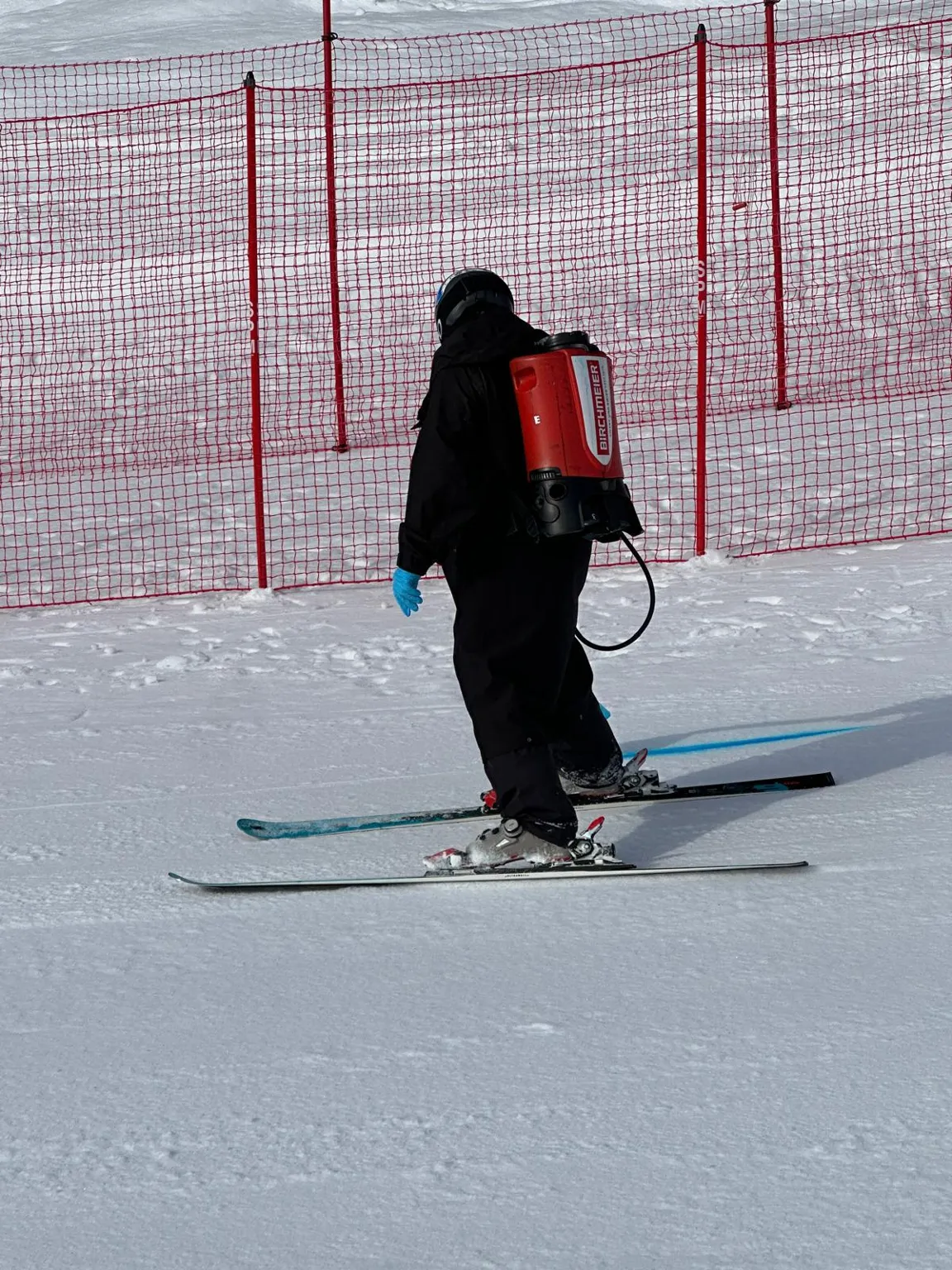
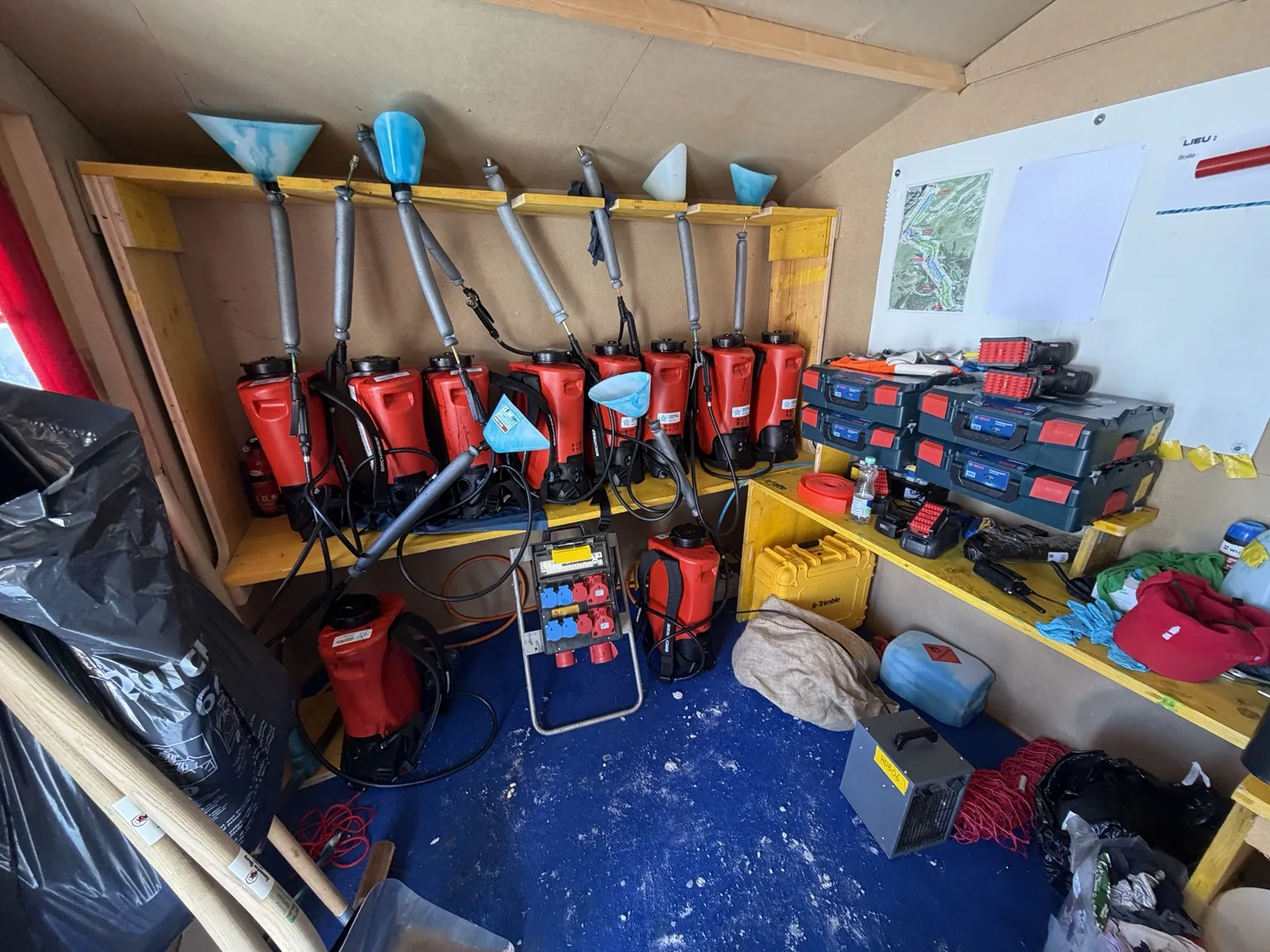
At our house, we call it the “backpack sprayer”. Birchmeier developed this backpack sprayer for the Picasso work. It carries a tank of 15 liters and a CAS battery of 18V / 72Wh.
At the end of the lance, a bell helps guide the jet close to the snow. The manufacturer offers two plug-in bells for this model, one oval, the other round, 12.5 cm in diameter.
On the snow
One hand on the lance, both skis engaged in the slope. You must maintain your balance and regular movement, even when the ground changes under your feet.
How much does the full backpack sprayer weigh on the back of a Picasso?
About 25 kg. And to wield the spear, we go down without sticks!
The Picasso crew’s battery-powered backpack sprayer
Pick out a black hose leading from a red tank to a lance. The blue hood at the tip surrounds the nozzle. The pump sits inside the machine.
Inside our backpack sprayer
Birchmeier identifies our machine as the REB 15 AC3 “EU” piste backpack sprayer, article 12107401. The tank holds 15 litres. A removable 18 V / 72 Wh CAS battery powers the electric pump. The team’s charger runs on a 230 V supply.
How does the dye reach the snow?
The pump draws mixture from the tank and feeds it into the hose. Squeezing the trigger opens the flow to the lance. The nozzle shapes the spray, and the hood helps limit drift.
The piste model has continuously adjustable electronic pressure control. For a given nozzle, increasing pressure usually increases flow and can produce finer droplets. To find the actual flow at your lance, collect the discharge over a measured time.
Our battery-powered backpack sprayer
Equipment
Piste version
Tank and filling
15 L, wide opening with a particle strainer
Pump and pressure
Stepless electronic control from 1 to 3 bar, with pump and battery protection
Battery and charging
Quick-change 18 V / 72 Wh CAS battery, charging station included
Rated endurance
12 hours or 260 litres at 1.5 bar
Lance, nozzle and hose
100 cm brass lance, flat-fan nozzle supplied, hose stays flexible in the cold
At Crans-Montana we set every sprayer to 3 bar, with both the flat-fan 6504 and the round Duro. Everyone starts with the same setting and adjusts their movements to the terrain. The electric pump regulates pressure without hand pumping.
The 12 hours or 260 litres quoted for the unit apply at 1.5 bar. At 3 bar, runtime depends on the nozzle, time spent spraying, cold and battery condition. We keep spare batteries in the hut. Comparing the two nozzles on our own kit calls for tests at 3 bar with our actual mix.
Refilling and recharging in the hut
Stand the sprayer on a stable surface and fill through the clean tank strainer to keep debris out. Stay within the tank capacity and close the lid. Keep mixture away from electrical contacts and the charging area.
At Crans-Montana the batteries return to the hut between runs. Separate charged packs from those waiting to charge. Record spraying time with the same nozzle and pressure setting to plan battery changes. We have no measured battery runtime for race conditions.
Winter limits and maintenance
Birchmeier specifies 5 to 30 °C for the REB 15 AC1, AC2 and AC5. The limits for our AC3 piste version still need confirmation from the manufacturer. Race conditions may fall outside the permitted range. Adding antifreeze to the mix does not by itself protect the pump, seals or battery.
Before opening a fitting, switch off the sprayer, release pressure as directed in its manual and remove the battery. Collect residual liquid, rinse according to the product and equipment instructions, and store the drained system in a frost-free place. Check filters and seals. Confirm chemical compatibility with the pump and seals before switching products.
Use a compatible charger in a dry place and within the temperature limits of both pack and charger. Set damaged packs aside.
Troubleshooting in the hut
What you notice
First check
The motor will not start.
Check that the battery is charged and seated. If the fault persists, take the sprayer out of service and hand it to the person responsible for equipment.
The motor runs but the spray gets weaker.
Check the liquid level, hose routing and signs of ice. With the unit off and depressurised, check the filters and nozzle before changing the pressure setting.
The spray pattern is distorted.
Compare the pattern with a sound nozzle of the same type. Check the tip’s orientation and look for debris or wear around the orifice.
A fitting leaks.
Stop spraying. Release pressure and have the seal and fitting checked. Check for leaks before returning the unit to service.
Documentation
The team model is identified in Birchmeier’s equipment quotation for the AC3 piste sprayer, article 12107401. The public manual below covers other REB 15 variants. The piste equipment catalogue lists the AC3 and its pressure control separately.